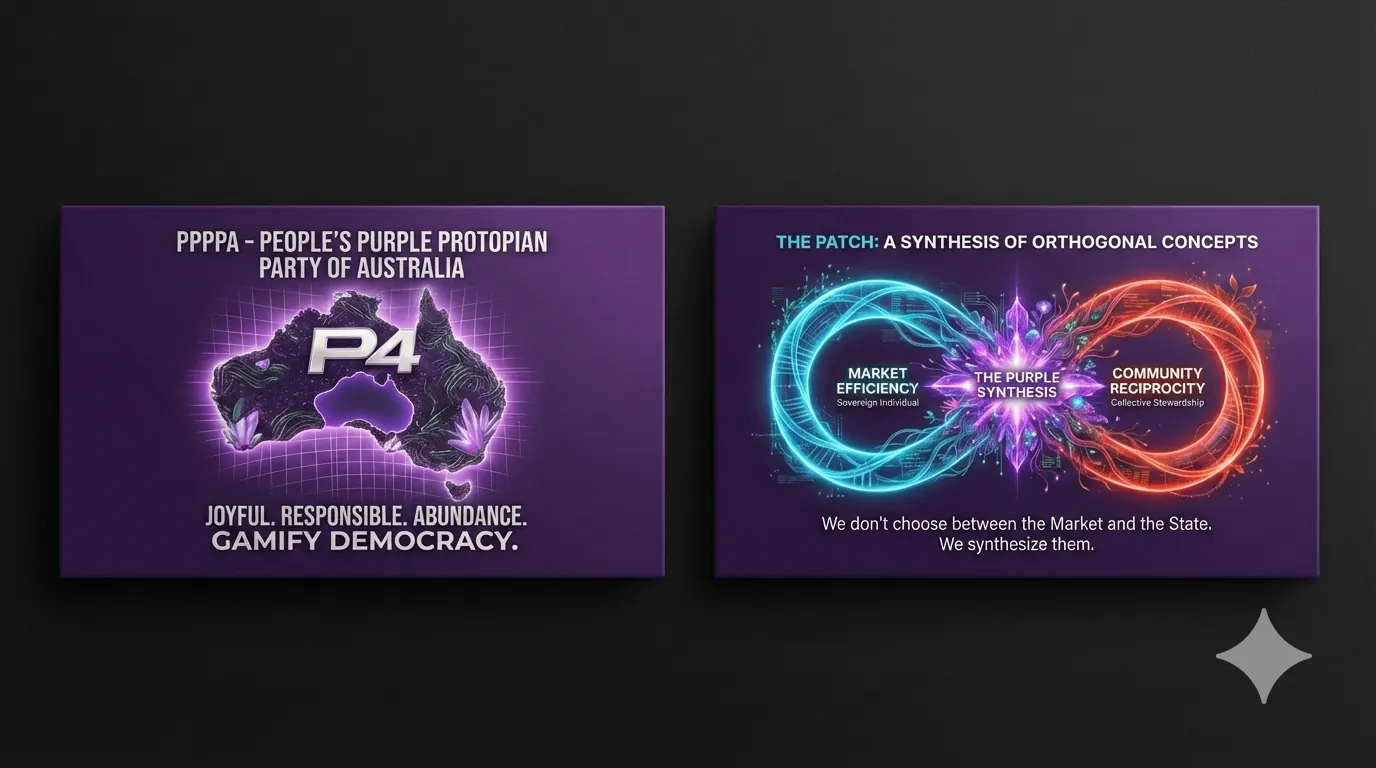
P4A patch synthesis artwork

Policy room / Twinkle follow-through

Risk and Mutual Care

The insurance gripe opens into a bigger civic room: prevention, mutual care, lawful risk pools, reinsurance and community wealth funds.

Twinkle 03 / Brainstorming scenario

Insurance: AI legal help, then mutual protection

Start with AI-assisted legal and contract support so ordinary people can understand a policy, find the relevant law and challenge a decision. Relevance framework and the Australian Legal Engine would underpin the source trail. Community mutuals and conventional insurance would then address the protection people actually need.

The first obstacle is often a contract nobody understands. Relevance explains how to follow legal threads; the Legal Engine retrieves quoted source provisions. AI could help apply that source trail to an insurance question before a mutual or insurer covers the risk.

Explore the connected work

How it could work

  1. A person could compare their contract, exclusions, insurer correspondence and source-linked provisions, with AI helping draft questions and organise evidence. The Legal Engine retrieves and cites provisions; it does not decide the case.
  2. A community could develop mutually governed protection, prevention and reserves, with clear contributions, benefits and catastrophe arrangements.
  3. Conventional insurance, reinsurance, independent disputes and professional representation would cover the remaining risks and escalation. Each layer would show what is promised and who pays.

Everyday example

After a denied claim, a household first gets help finding the contract clause and relevant source law. It then knows what to challenge, what a mutual could cover and what still needs an insurer or lawyer.

Who could act and how it could be funded

Shared local computing and legal-information tools could lower the cost of first assistance; a funded human escalation pathway would handle matters requiring advice or representation. Mutual capital, premiums and public prevention funding would stay separately accounted for.

Fair-go safeguards

Current provisions and policy wording must be checked; an old corpus is not current law. Private documents stay under chosen permissions. AI does not invent authorities or issue a legal verdict. Mutual participation is voluntary.

What would show progress

Contracts understood; source citations checked; disputes resolved; representation costs; reserve strength; household protection.

Twinkle 21 / Brainstorming scenario

Climate and deep time: plan beyond the next flood

Use local climate-risk scenarios to guide housing, infrastructure, insurance prevention and a fair transition. Flood resilience is one part of a wider plan covering heat, fire, water and emissions exposure.

A digital twin is a model of a real place or system. It could help communities compare heat, flood, fire and service scenarios before making expensive physical changes.

Explore the connected work

How it could work

  1. Publish ranges and time horizons for local risks, with communities able to question assumptions.
  2. Prioritise practical protection and emissions reduction with immediate benefits: efficient homes, reliable energy, safer siting and resilient services.
  3. Budget for maintenance, workforce transition and locally agreed relocation where needed, with regular scenario reviews.

Everyday example

An older renter gets a cooler, more efficient home now while the council stops planning essential facilities around yesterday's flood map.

Who could act and how it could be funded

States and councils lead much land-use, infrastructure and adaptation delivery; national emissions and funding settings need Commonwealth partnership. Rank projects by avoided harm, useful service and full lifecycle cost.

Fair-go safeguards

No forced exposure of homes or personal vulnerability. Relocation requires fair terms and meaningful choice. Uncertain scenarios must not be presented as exact predictions.

What would show progress

Heat and disaster exposure reduced; bills; service continuity; emissions impact; fair transition outcomes; assumptions updated.

Full room: ideas, tools and sources

Delivery roles: Australia's three levels of government · Victoria's parliamentary responsibilities.

Plain hook

Risk should not become rent.

P4A can explore community risk and mutual-care models where lawful: discretionary mutual funds, co-operative reserves, transparent risk pools, prevention grants and reinsurance for the risks too large for any local group to carry alone.

Mutual care modules

Reduce risk firstEvery pool starts with practical prevention: safer homes, heat plans, drainage, vegetation, batteries, health support and local disaster readiness.
Mutual reservesMembers can build transparent reserves for smaller recurring risks, with clear rules, audits and no fake certainty.
Reinsurance bridgeCatastrophic risks still need regulated insurance and reinsurance. The goal is to reduce exposure, not pretend cyclones read policy documents.

L2 wealth funds

The L2 layer is where regional wealth can become resilience capital. Community sovereign wealth funds could hold returns from public power generation, infrastructure, local enterprise and natural-resource value, then support risk reduction, community loans, food resilience and mutual insurance reserves.

External example

Moreton Bay Community Wealth and Mutual Care.

The linked Aura of Intelligence repo explores the same practical lane in a local archipelago frame: community wealth funds, mutual protection, personal and Indigenous data sovereignty, Native Title and Country-led deal pathways, and everyday choices for groups that need simple language before technical detail.

This link leaves P4A. Treat it as a research doorway and example pattern, not legal, financial, cultural, insurance, tax or investment advice.

National/Oceania frame

Australia and Oceania need insurance models that reward prevention and local capacity. Where for-profit cover is essential, keep it. Where communities can lawfully pool risk and fund prevention, give them clean governance, plain-language rules and serious audit trails.

Deep time: climate change and the planning horizon

The Deep time gripe is about climate change and the mismatch between long-term risks and short political planning cycles. Flooding is the example below, not the whole subject.

A one-in-100 annual chance does not promise a century between floods. Repeated events can occur, and changed climate, drainage, land use or catchment conditions can change the risk. Read the model’s date, scenarios and limits before treating a historical label as a guarantee.

Protect and adaptDrainage, raised services and building work can lower damage; residual risk and downstream effects remain.
Change where and how we buildPlanning limits and voluntary relocation can reduce exposure but affect home, livelihood, community and public budgets.
Insurance and mutual supportCan spread financial shocks while exclusions, affordability, reinsurance and lawful operation need careful design. It does not physically prevent a flood.

Mutual Care proposes prevention and shared risk reserves; its assumptions need comparison with actual hazards and cover. Ask council for the latest flood study and evacuation information, then test alternatives in a public model without publishing household vulnerability. Deep time is the climate-change topic; flooding is one example. Ancient aliens remains a separate topic.

From the original Twinkle seeds

Earlier clip briefs and proposals are kept here alongside the current evidence and options above. These are exploratory ideas, not adopted policy.

Twinkle 03 - earlier seed and related proposals

A household-budget clip about premiums, risk and the obvious question: what can communities lawfully pool, prevent and fund before everything becomes unaffordable?

Clip brief

The everyday gripe

Someone stares at the wall and says the quiet part: if premiums keep rising, prevention has to become cheaper than panic. The clip opens into community mutuals, legal guardrails, reinsurance, risk reduction and L2 wealth funds backed by real assets.

Description

BaitInsurance anxiety is already a kitchen-table issue across fire, flood, health and housing.
SwitchNot every risk should be exported to a distant premium machine if communities can reduce and pool parts of it lawfully.
SystemCommunity reserves, reinsurance and L2 wealth funds turn prevention into infrastructure.

Back to Twinkle 03

Twinkle 21 - earlier seed and related proposals

A sandbag rant about a calendar that has clearly stopped working, then a hard turn into planning on nature's clock instead of the news cycle.

Open seed

The everyday gripe

Straight to camera, gumboots in shot: that's the third one-in-a-hundred-year event this decade, the insurance letter says the suburb is now a "flood-prone lifestyle", and the recovery fund gets announced faster than the prevention budget ever did. Nature runs on deep time; budgets run on Tuesdays. The trapdoor is the mismatch itself: public risk models anyone can read, and prevention funded like we actually believe them. This seed is open: film your own cooked-calendar rant.

Description

BaitEveryone has lived a "once in a century" event recently, and everyone has noticed the phrase wearing out.
SwitchFrom arguing about causes to arguing about clocks: the threats are patient, the planning horizon is not, and that mismatch is the actual existential risk.
SystemRisk and mutual care for prevention and lawful pooling, with the Sensorium's open models letting any community read its own risk in deep time.

The one-breath drop

Said before the flush

"Plan on nature's calendar, not the news cycle: public risk models, prevention funded like we believe them." Second breath lives in the room.

Back to Twinkle 21