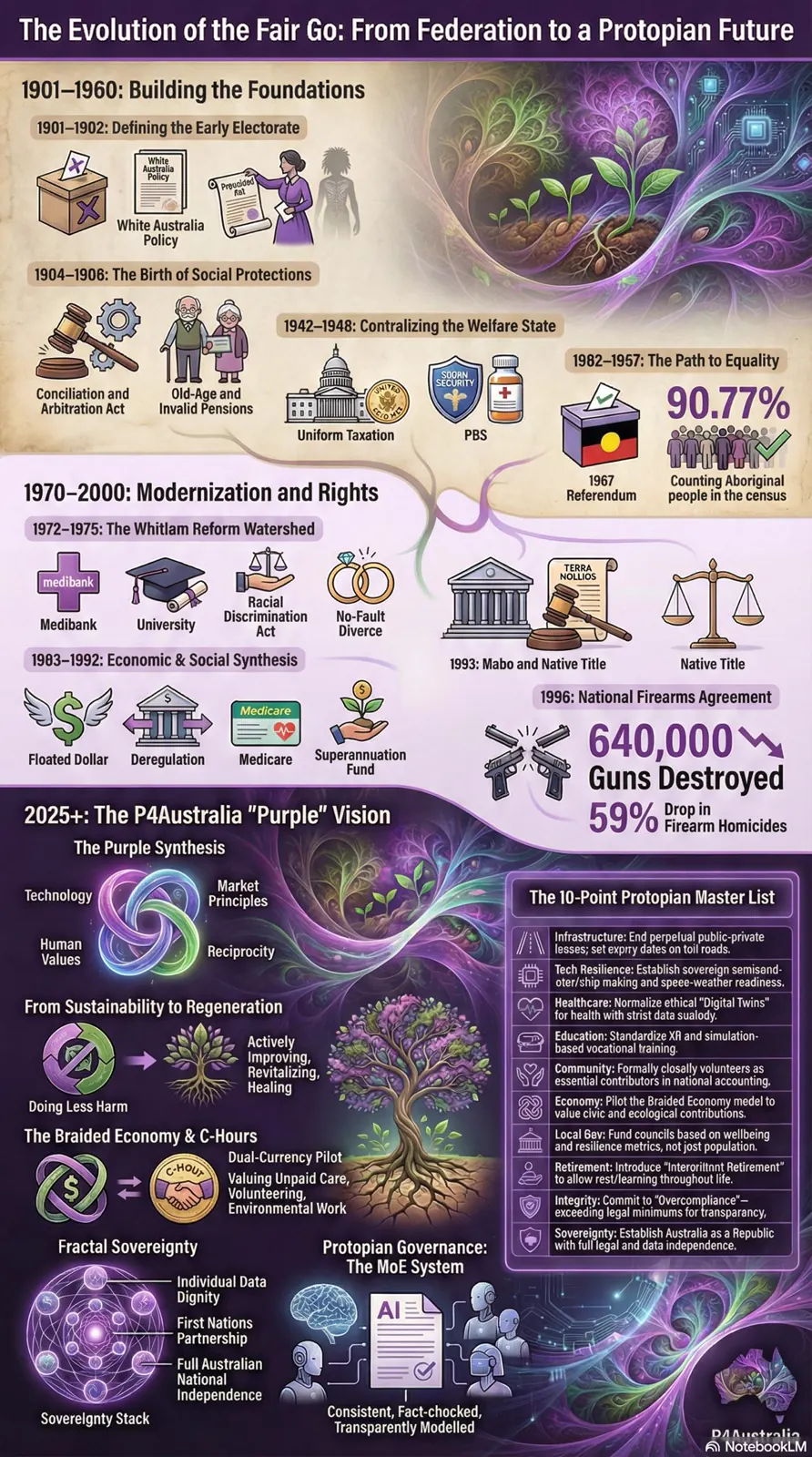
The Fair Go Evolves visual reference

Fair Go foundation / National story

The Fair Go Evolves

The Fair Go is not a museum magnet or a speechwriter's emergency garnish. It is the Australian test: can ordinary people build a decent life without needing rich parents, a secret handshake or a miracle spreadsheet?

Twinkle / policy room

Connected Twinkles

Twinkle 09 / Brainstorming scenario

Childcare: funded care and C-Hour recognition

Care could be treated as essential infrastructure, with affordable places, usable hours and properly paid educators. C-Hours would separately recognise voluntary family and community care that ordinary economic accounts overlook. Mutual Futures and the women-led 500 Queens work provide further paths into care, enterprise and leadership.

Paid childcare and voluntary family care are different contributions to the same everyday need. The C-Hour idea would recognise willing care without converting it into cheap labour or making a child’s place conditional.

Explore the connected work

How it could work

  1. Public, community and co-operative services could match places and hours to real family needs, with transparent operating costs and stable educator roles.
  2. One verified hour of freely chosen community contribution could be recognised as one C-Hour, including suitable caring, mentoring and organising agreed with participants.
  3. The money, contribution and outcome records would remain distinct: wages pay professional work, C-Hours recognise voluntary time, and results show whether children and families are better supported.

Everyday example

An educator receives a proper wage. A grandparent who chooses to help could receive C-Hour recognition under locally agreed rules. A child’s place does not depend on either parent volunteering.

Who could act and how it could be funded

Governments, care providers, families and co-operatives could combine care funding, suitable premises and shared tools. C-Hour recognition would sit alongside paid provision, not reduce its wage or staffing budget.

Fair-go safeguards

Care is valuable whether a parent takes paid work or not. No compulsory volunteering to keep a place. Child wellbeing and educator quality are outcomes, not obstacles to cheap provision.

What would show progress

Usable care; net family cost; educator retention; voluntary caring recognised; child wellbeing; family choice.

Full room: ideas, tools and sources

Delivery roles: Australia's three levels of government · Victoria's parliamentary responsibilities.

Plain test

A Fair Go should survive contact with rent.

If the national promise only works for people who already own the ladder, it is not a ladder. It is home decor. The modern Fair Go has to show up in rent, housing, care, work, food, law, public assets and local trust, not just in campaign speeches wearing an Akubra it did not earn.

P4A's version is deliberately practical: make the rules readable, make the receipts visible, make local help easier to organise, and stop treating ordinary people like they failed a hidden exam.

What went stale

The slogan is still good. The machinery is tired.

Homes became a scoreboardWhen shelter turns into a wealth race, the person trying to start a life gets told to run faster while the track is being sold behind them.
Care became invisibleFamilies, volunteers, carers and neighbours hold the place together, then get rewarded with a nice speech and a parking problem.
Law became fogIf people cannot understand the rules without hiring a translator in a suit, the rules are not public enough.
Public assets got sleepyRoads, land, energy, data and long contracts should not drift into forever-deals while everyone else is told to tighten their belt.
Work changed shapeAI, automation and casualisation mean a fair go cannot just mean one job, one boss, one mortgage and a prayer to the interest-rate weather.
Trust got expensiveWhen every promise needs a scandal before it gets audited, the public pays twice: once in money, once in cynicism.

P4A upgrade kit

Less sermon, more system.

Homes firstModel housing as a right, with ownership, stewardship, public stock, co-ops and scheduled maintenance or repair, and where homelessness is treated as design failure, not background weather.
Readable lawLegal memory should be cited, plain-English and human-reviewed so people can see what power can and cannot do.
Public ledgersMoney, time, promises, corrections and conflicts should leave trails. A good receipt is democracy's least glamorous superhero.
C-HoursVerified community contribution should matter beside money: care, repair, mentoring, disaster readiness, food systems and local stewardship.
Local firstStart with households, streets, clubs, co-ops and councils. Canberra should not be the first place an idea becomes real.
Humour with receiptsMake politics easier to enter without making truth optional. The joke opens the door; the evidence keeps it from becoming a circus tent.

Fair Go questions

Run every policy through the pub test and the audit test.

Can a normal person use it?If the pathway needs three consultants, a cousin in finance and a sacrificial weekend, simplify it.
Does it lower the first step?A fair system reduces the cash, paperwork, confidence and insider-language barriers to starting.
Who carries the risk?If profit is private but risk keeps landing on renters, workers, councils or rivers, the ledger is lying.
Can people correct it?A Fair Go needs appeal paths, mistake repair and public correction without turning every citizen into a full-time complaints department.
Does it reward repair?Care, maintenance, prevention and stewardship should count before crisis becomes the only funded doorway.
Does it scale without bullying?The system should grow from consent, proof and usefulness, not a top-down megaphone yelling "community" at people.

Where it gets real

The Fair Go needs rooms, not vibes.

Housing is the sharp edge. Food is the weekly edge. Insurance is the risk edge. Legal memory is the power edge. Public ledgers are the trust edge. Put them together and the Fair Go stops being a nostalgic cuddle and starts behaving like civic infrastructure.

Australian continuity

Australia has upgraded before: arbitration, pensions, public health, education, Medicare, voting rights, native title, disability support, disaster response and public infrastructure. None of it was perfect. Most of it was argued into existence by people who were told to calm down. That is the tradition worth keeping: practical improvement with enough cheek left in it to notice when the emperor has a developer's brochure.

Connected project: UNGA81: capability and a fair go

A contribution on capability, public participation and a fair go. It is not an official UN endorsement.

From the original Twinkle seeds

Earlier clip briefs and proposals are kept here alongside the current evidence and options above. These are exploratory ideas, not adopted policy.

Twinkle 09 - earlier seed and related proposals

A kitchen-table rant about childcare costing so much that going back to work barely pays, then a hard turn into funding care like the infrastructure it is.

Open seed

The everyday gripe

Straight to camera: the daycare invoice lands and it reads like rent. One parent is doing the maths on whether working even pays after fees, and the country wonders where its workforce went. The trapdoor is a room where care is treated as infrastructure: funded like roads, counted like contribution, and measured by the parents and grandparents it frees. This seed is open: film your own invoice reading.

Description

BaitAustralian families pay near the top of the developed world for childcare, and fees keep rising faster than pay. Every young family has done the sums: work the extra day, lose the extra day to fees.
SwitchFrom "babysitting is dear" to "care is the infrastructure everything else stands on", including the workforce debate everyone claims to care about.
SystemFund care like roads and power, because it is infrastructure: it pays for itself in parents who can work and kids who get a proper start.

The one-breath drop

Said before the flush

"Call care what it is: infrastructure. Fund it like roads and count the parents it puts back to work." Second breath lives in the room.

Back to Twinkle 09