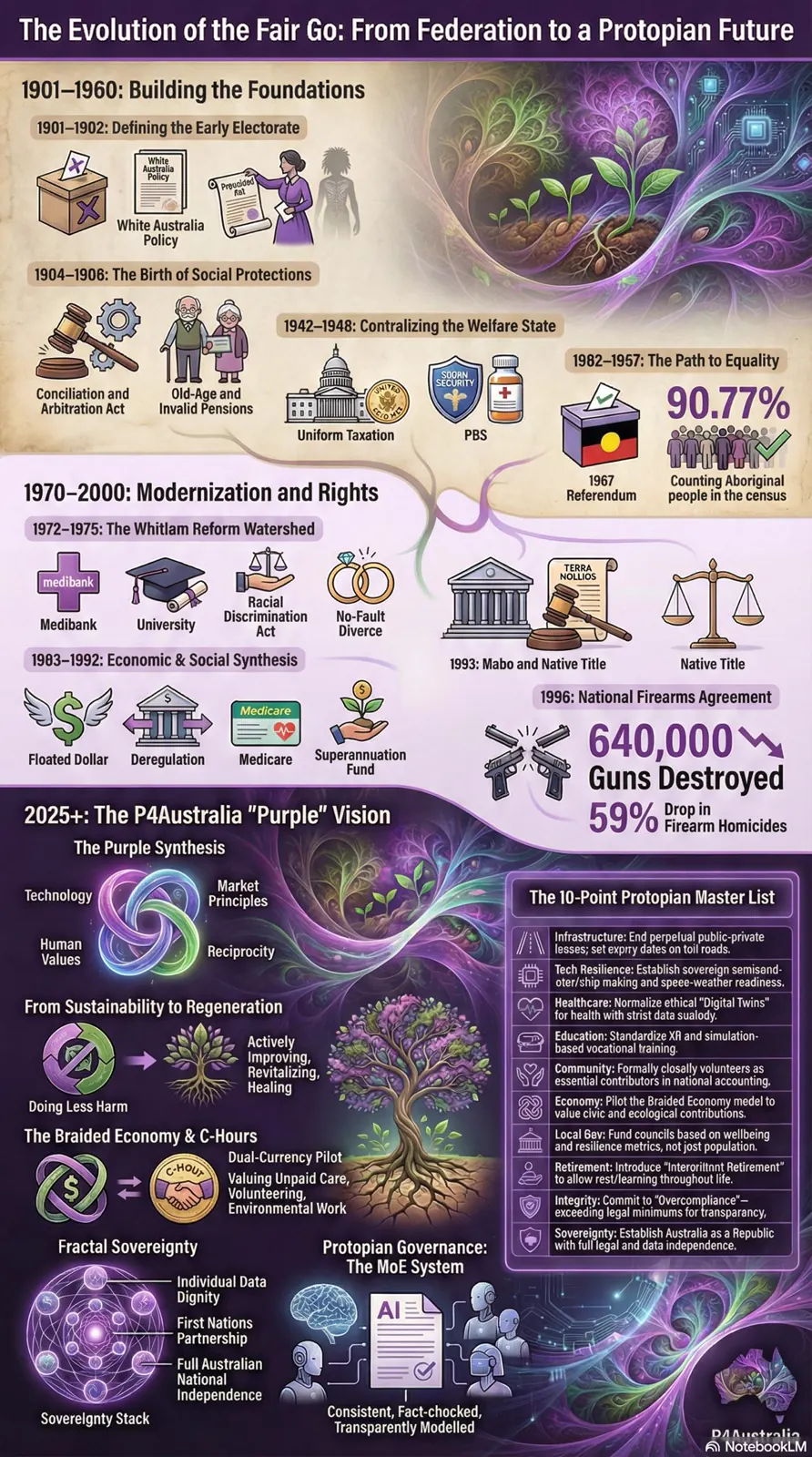
Evolution of the Fair Go infographic with protopian future elements

19B / Clinical path

Care before spectacle.

Aura Genesis only earns trust if the grounded version helps people: dementia support, digital memoirs, carer relief, wellbeing reports and ethical AI health pathways.

Twinkle 07 / Brainstorming scenario

GP care: AI as a duty to check, not just type

A proposed standard of care would expect clinicians to use suitable, validated AI assistance when it improves ethical overcompliance: more thorough checks of consent, prescribing, interactions, follow-up and unusual problems. Unjustified failure to use an available beneficial tool would be reviewable as a possible lapse in care. AI could also return paperwork time to patients.

Ethical overcompliance means using useful checks to do more than the bare minimum. The idea includes prescribing checks, unusual-case investigation, consent and follow-up, with AI saving time and clinicians retaining judgement.

Explore the connected work

How it could work

  1. A clinician-controlled assistant could check medicines, allergies, interactions, missing information and follow-up duties, and prepare prescriptions for the clinician to verify and authorise.
  2. For irregular or unresolved problems, AI could help search evidence and alternative explanations, making uncertainty and source quality visible for professional review.
  3. The system could draft records and correspondence, flag missed obligations and record reasons for overriding a useful check. Care funding would reward time, continuity and prevention.

Everyday example

When symptoms do not fit the usual pattern, a GP could use a source-linked second check, review the medication history and follow up an unresolved issue rather than repeat a rushed default answer.

Who could act and how it could be funded

Clinical bodies, practices, public health services and regulators could develop the standard, approved tools, training and audit pathway. Funding would cover clinician time, integration, security and independent evaluation.

Fair-go safeguards

The negligence proposal concerns a future professional standard, not a claim about existing law. Clinicians remain accountable; AI does not prescribe autonomously. Consent, privacy, evidence quality and a non-AI care route are part of the design.

What would show progress

Missed issues detected; prescribing checks completed; useful follow-up; clinician time returned; patient outcomes; audit findings.

Twinkle 22 / Brainstorming scenario

PTSD claims: one claim, one human, timely care

Give each claimant one accountable human and start an appropriate care pathway while administration is resolved. The department carries the coordination burden, rather than repeatedly asking the person to relive the same account.

Care and claims administration should not make a person recount the same trauma to every office. One accountable human and an authorised record could keep the pathway together.

Explore the connected work

How it could work

  1. Assign a named navigator and a claim plan with visible dates, responsibilities and escalation.
  2. Reuse authorised evidence across forms; a clinician reviews any assisted summary before it is relied on.
  3. Set enforceable agency response standards with independent escalation, continuity of care and a recorded explanation for delay.

Everyday example

A veteran or first responder tells the necessary story once, knows who owns the claim and has someone to call when it stalls.

Who could act and how it could be funded

Veterans' administration needs Commonwealth delivery; states and employers participate in relevant first-responder systems. Fund navigators, care access and secure administrative support, keeping the dementia research programme separate.

Fair-go safeguards

Consent controls evidence reuse. Care access is not a promise of automatic compensation approval. No automated adverse decision or public disclosure of trauma.

What would show progress

Time to first care; repeated evidence requests; unresolved claims; continuity; claimant control and navigator availability.

Full room: ideas, tools and sources

Delivery roles: Australia's three levels of government · Victoria's parliamentary responsibilities.

Real de-slop

Make health AI boringly useful.

The public-facing magic is a life story people want to use. The serious layer is a clinical wrapper: structured evidence, consent, safety, privacy, clinician-readable reports and clear limits on what the system can claim.

Three practical pathways

MemoryDigital memoirs

Photos, stories, places, songs, values, routines and family knowledge become a living memory map with clear consent settings.

CareDementia support

Track quality of life, function, behaviour triggers, calm prompts, carer burden and useful patterns over time.

WellbeingHealth readiness

Use AI-guided reflection and biosensor summaries to help people notice stress, sleep, recovery, social connection and support needs earlier.

Australian health stack

Clinical evidence ladder

Phase 1Feasibility with small participant-carer dyads: usability, consent, safety, comprehension and whether people actually use it.
Phase 2Pilot study with clinical partners: quality-of-life, function, carer burden and report usefulness.
Phase 3Regulatory and funding evidence: technical file, privacy, cybersecurity, human factors and professional adoption.

Anti-slop rules

Do not diagnose from vibes.
Do not call a mirror a doctor.
Do not sell surveillance as care.
Do not make families repeat the same story to every system.

Source anchors

Medicare is the universal health insurance scheme, PBS medicines sit inside Medicare access, private insurance premiums changed in 2026, and NDIS funds eligible disability supports. Medical software claims would need the TGA software-based medical device pathway and human research needs ethics discipline.

PTSD care and the wider care system

The PTSD Twinkle focuses particularly on veterans and first responders, including the burden of repeating traumatic histories through claim forms. Trauma-informed care needs continuity, consent, choice and an affordable path to qualified help. Administrative relief is useful only if people can still reach a human, correct records and refuse automated handling. A digital navigation proposal does not establish clinical effectiveness.

A named care coordinatorMay reduce repeated histories and missed handovers, but needs time, training and consent.
Peer and community supportCan reduce isolation and improve navigation with paid supervision; it complements clinical treatment.
Accessible specialist pathwaysNeed funding, workforce and regional access, not simply a new referral form.

Care pathways should be evaluated on waiting time, continuity, patient choice and safe escalation. Ask services for private consumer-feedback routes. Public advocacy can describe a system failure without exposing a person’s trauma history.

From the original Twinkle seeds

Earlier clip briefs and proposals are kept here alongside the current evidence and options above. These are exploratory ideas, not adopted policy.

Twinkle 07 - earlier seed and related proposals

A waiting-room rant about gap fees, ten-minute medicine and appointments that arrive next Thursday week, then a hard turn into care hours, paperwork-eating AI and prevention that actually gets funded.

Open seed

The everyday gripe

Straight to camera: the gap fee is forty bucks, the appointment is Thursday week, and the diagnosis is "it's viral, drink fluids, that'll be the card machine". The doctor isn't the villain; the doctor is drowning in billing codes. The trapdoor is a health lane where care hours get funded, machines carry the paperwork, and prevention is a line item instead of a slogan. This seed is open: film your own waiting room.

Description

BaitBarely one GP in ten can bulk-bill everyone now, and people are visibly skipping care because of the gap. Everyone has a waiting-room story.
SwitchOff the doctor's back and onto the machinery: rebates frozen against costs, six-minute medicine, and a system that pays for throughput instead of health.
SystemThe clinical path: care hours funded directly, assistive AI eating the admin, human judgement kept where it belongs, prevention counted as care.

The one-breath drop

Said before the flush

"Fund care hours, not billing codes, and make the AI do the paperwork so the doctor can actually look at you." Second breath lives in the room.

Back to Twinkle 07

Twinkle 22 - earlier seed and related proposals

The quiet Twinkle. Same format, different rules: no toilet, no gag, and the joke stops halfway on purpose. For the veterans and first responders whose dark humour already carries this, then a hard turn into care that starts the day you ask.

Open seed / quiet variant

The everyday gripe

Any quiet place: the ute tray, the shed, the end of the jetty. The rant starts like the others, dark and funny the way veterans and first responders already tell it: the deployment was fine, it's the claim form that needs a support animal. Then, halfway, the clip goes quiet on purpose, because the punchline is that people died waiting for paperwork. The joke belongs to the people who carry it, aimed only at the machinery: backlogs measured in years, forms that ask the same wound to be described five times. This seed is open, and it asks for more care than the others: never at the person, never at their service, always at the system.

Description

BaitThe dark humour already exists in every mess hall, ambulance bay and fire station in the country. This format just gives it a doorway.
SwitchThe laughter stopping is the switch. A Royal Commission spelled out what the backlog costs in lives; the clip does not need to raise its voice about it.
SystemThe clinical path plus mutual care: care that starts on request rather than on approval, one human owning each claim, and a deadline that binds the department instead of the person.

The one-breath drop

Said in the quiet

"One claim, one human, one deadline the department has to meet. Care starts the day you ask." Second breath lives in the room.

Back to Twinkle 22